I enjoy reading books about history, but that was not always the case. Do you remember the type of books we were handed in class? You know, a quick overview of dates, names, events and places? Yah - for me they were a super snooze fest and I groaned every time I heard the words "history books" or "history class". So when I started homeschooling my children, I was concerned my attitude towards history would be a problem. Kids are smart and can pick up on those attitudes. Unit studies made me aware of "living history" and it changed my attitude towards history. Those books brought history to life. I went from hating history to loving it! My children had the same attitude and majored in history in college.
With all that said, I am always searching for my next non-fiction read. I have heard MANY good things about Bill O'Reilly's series and decided to break down and purchase one of his books to see if it is as good as it was touted to be. I chose "Killing the Witches: The Horror of Salem, Massachusetts" which is the latest installment of his "Killing series". I had a hard time choosing which in the series to read first, but settled on this one, since it was the latest book and when I read the sample on Amazon, I thought it would be an interesting read.
The book is well written and is easy and enjoyable to read. It has many footnotes (yes, I really do read them all!) and I have found them to be helpful. I enjoy the storytelling - giving personalities to those written about. Did you know that Myles Standish had a temper? I am going to dig more into that after I finish the book, but I found it quite interesting since I always imagined a Pilgrim to be very calm and even-tempered since they were so "religous".
I am not very far into the book, but I wanted to post about how much I am enjoying it. I wish I had more time in the day to just sit down and read for an afternoon, but I won't really have time to do that until the weather turns cold. Then it will be the perfect time to curl up under an afghan with a hot cuppa and a good book to read.
If the book or series interests you, make sure to visit Amazon and read the sample that is posted and look at Bill O'Reilly's other books. They all look fascinating!
The American Patriot's Bible, KJV The Word of God and the Shaping of America
By Dr. Richard Lee
Format: Hardcover
Edging: White
Trim Size: 7.30 x 9.40 x 1.80
Page Count: 1640
Retail Price: $44.99
ISBN: 9781418548919
My first impression of "The American Patriot's Bible" was how well constructed and beautiful it is. The hard binding is nice and tight and lays flat making it easy to read. In the beginning is an illustrated presentation plate and numerous pages for your family records, ie: husband and wife family tree, children, grandchildren, church and service records, deaths, and even a place for special family history and ancestors of interest. Also included is a map of the United States, a chart when the states were added and the Seven Principals of Judeo-Christian Ethic (which our forefathers followed).
There is so much to love about this Bible. It is not only beautiful to look at, but full of information that made our United States a great nation. There are full color pages that highlight important parts of US history and throughout the Bible are many famous people who were important to making the United States a great nation. There were many moving articles, but one sticks out for me: the founder of the Hilton Hotel chain had a prayer printed in many well known magazines on July 4, 1952 -this prayer is included in its entirety.
This is the King James Version (KJV) and is one that every American would be proud to have in their Christian library. Because of its beauty and theme, this is perfect for gift-giving and would make a wonderful gift for those who are serving or have served in the armed forces. It would also be a wonderful gift for that favorite history student or teacher.
About This Bible:
THE ONE BIBLE THAT SHOWS HOW ‘A LIGHT FROM ABOVE’ SHAPED OUR NATION. Never has a version of the Bible targeted the spiritual needs of those who love our country more than The American Patriot’s Bible. This extremely unique Bible shows how the history of the United States connects the people and events of the Bible to our lives in a modern world. The story of the United States is wonderfully woven into the teachings of the Bible and includes a beautiful full-color family record section, memorable images from our nation’s history and hundreds of enlightening articles which complement the historic King James Version Bible text.
Features include:
Full-color presentation and family record section
48 beautiful full-color insert pages including memorable images from America's history
The historic King James Version Bible text, large print
1600 Bible pages (illustrated, two-color) with: 80 full-page articles, 70 half-page articles, 104 quarter-page articles, and 66 book introductions
Index and concordance
This Bible is part of the Signature Series line of Thomas Nelson Bibles. American Patriot's Bibles sold to date: More than 125,000 The King James Version—The most successful Bible translation in history with billions of copies published.
I received this Bible through the Booksneeze program. I was not required to write a positive review, but instead, one that gives my honest opinion.
Today's feature is a treat for me. I had the chance to interview Christine Blevins and as you will see, she is such an intriguing person. If you haven't read any of her books, please make sure to add at least one to your TBR list. Her talented way in which she brings history to guaranteed to captivate anyone who picks up one of her books! If you are just arriving here, make sure to read Christine's guest post, read my review of The Turning of Anne Merrick, and don't miss out on a chance to win the 18th Century writing pack that Christine is offering to one lucky reader!
Welcome, Christine! It is such a pleasure to have you with us today. In one sentence, describe "The Turning of Anne Merrick". When the penalty for spying was death, Anne Merrick was a spy. What inspired you to write this novel? Although I’ve always been enamored with revolution of any sort, and the American Revolution specifically, the idea for an American Revolution story was inspired by a single unrelated note I jotted down when researching 18th century ocean travel for my debut novel, Midwife of the Blue Ridge: “NYC occupied by British 1776-1784.” This note eventually sent me on a research tear that resulted in the tale of a New York woman – not the daughter, or wife or mistress or maid of any historically famous man – just an ordinary woman who gets swept up by remarkable events taking place around her.
How much research do you do on a subject before you decide to write? A lot. Enough to really know the setting, culture, and current events of the time period as a base, and then there’s the research I do along the way, as there is always something I don’t know as I move forward with the writing. I’ve learned it is always best for me to be always doing some specific reading as I write – to give the writing immediacy. For example, in conjunction with writing the Valley Forge segment of The Turning of Anne Merrick, I read a book titled Ordeal at Valley Forge by John Joseph Stroud, which is a day-by-day chronicle compiled from a variety of primary sources. Who or what was your biggest influence in your decision to become a writer? I can’t say I ever actually decided to become a writer, but I did make a decision to start writing down a story that had popped into my head during a trip to Scotland. I don’t know if it was the gorgeous Scottish landscape that served as my muse, or simply the fact that my life had matured to a point that allowed me the time to develop a new passion. If you could spend one day with anyone, living or dead, who would it be and why? I would love to hang with Thomas Paine – my favorite Revolutionary – he is the Founding Father I find most fascinating. I begin each chapter of The Turning of Anne Merrick with a relevant quote from Paine’s The Crisis pamphlet series. I know some authors have unusual rituals when they write: a certain food, lock themselves in a room, only work at night, etc. What's yours? I will admit to having a few writing foibles: I always burn a certain candle while I write. The original candle – a scent called “Hemingway” from Hobby Lobby – was a Mother’s Day gift from my daughter Grace. I buy them by the dozen. I have certain music I play as I write – nothing with words in any language that I understand. Gaelic is good. My collection of writing tunes includes of movie soundracks, fiddle, and bagpipe music. How does writing work with family life? It can be difficult integrating writing – a pretty solitary and time consuming endeavor – within a busy and close-knit family. Though my kids are all grown, and busy with their own lives, we still seem to be together a lot. I have two small granddaughters (Gloria 4, and Felicity months) who I adore spending time with. To make it all work with deadlines etc. I am very lucky to have an extremely wonderful and supportive husband who helps me keep it all in balance. What things do you enjoy doing when you aren't writing? We have a lakehouse up north in Michigan where I go to smell the pines, watch birds, see the stars, and cook a lot of great food. This winter I’ve been into braising meats, making tamales, and reconditioning vintage cast iron cookware that I buy on the cheap at flea markets.
Would you share one thing most people don't about you? I didn’t speak learn to speak English until I went to kindergarten.
Tell us about your next project. I’m working on the third and last book in this American Revolution series that takes Anne, Jack and the gang down to the southern theater of the war, where more action, adventure and yes, a little romance ensues.
Thank you, Christine, for taking the time and allowing a small peek into your life. It has been such a pleasure hosting you for this tour.
Make sure to enter the giveaway for the 18th Century writing pack (see photo below) that Christine is giving to one lucky reader. This pack is sure to please!!
About the Author:
Author Christine Blevins writes what she loves to read – historical adventure stories. The Turning of Anne Merrick is Christine's third novel, and the second in a three-book series set during the American Revolution and War of Independence. A native Chicagoan, Christine lives in Elmhurst, Illinois along with her best friend and husband Brian, and The Dude, their very silly golden-doodle. She is at work finishing her next book inspired by a lifelong fascination with the foundations of American history and the revolutionary spirit.
For more information on Christine Blevins and her novels, please visit her WEBSITE. You can also find Christine on Facebook and Twitter:@Author_CBlevins
Make sure to visit the other blogs that are part of Christine's Tour and see what they have to say about "The Turning of Anne Merrick". You can view the full schedule here.
I'm so excited to be able to again host a stop for a very talented historical fiction author. Today we are returning with an informative and interesting guest post from Christine Blevins - the author of "The Turning of Anne Merrick" (see my review here). Christine is also giving one lucky reader a set of 18th Century paper goods complete with a quill pen (see below to enter). This set is one of the coolest prizes I've ever seen! Thank you so very much, Christine.
Up the Rebels!
I love history, but am particularly drawn to stories
involving insurrection, rebellion and revolution. Large or small, joyfully
successful or dismally inept, these political cataclysms have all the stuff I
look for in a great story.
“We have it in our power to begin the world over again.”
This sentence from Common
Sense, by Thomas Paine (one of my favorite revolutionaries) sums it all up
for me. It is perhaps ridiculously simplistic – the notion that we always have
the ability to change – to begin anew.
And spanning time and culture, and for reasons religious,
political, or economic, it happens – and often. Revolution. People rising up to
say enough is enough. Some lead, others follow, but together they muster the
strength to sacrifice and struggle in an effort make their world into a better
place. The American Revolution is a prime example.
But not all rebellions end well. History is rife with
examples of failed efforts. The Roman slave revolt was eventually squashed.
Spartacus was captured and he, plus 6,600 of his followers were crucified on
the Appian Way, their bodies left to hang for years as a warning to dissuade
budding revolutionaries. Scotland’s Jacobite Rising in 1745 did not restore
Bonnie Prince Charlie to the throne. The confederacy of Native American tribes
in Pontiac’s Rebellion did not drive the British from their lands, or put a
stop to colonial expansion.
Revolution can also create strange dichotomies. The French
Revolution propelled by cries of “liberté,
égalité, fraternité”
devolved into the Reign of Terror. Iconic Che Guevera is vilified as “the
butcher of La Cabaña” by some, but he is also prayed to as “Saint Ernesto” by
others.
And even the revolutions that are deemed successful don’t
ever seem to end in perfect solutions. The American Revolution created a
radical form of self-governance based on a constitution that left women unable
to vote and the slavery issue unresolved.
For all these reasons and many more, revolutions in both the
distant and recent past persist as the basis for novels, movies, and even
Broadway musicals. Within rebellion there lies a classic David and Goliath
quality – the weak making a courageous stand against the mighty. Revolts
inherently abound in conflicts where courageous heroes and martyrs face brutal,
tyrannical oppressors, creating veritable petri dishes for adventure and
romance to grow. Who can resist?
Author Christine Blevins writes what she loves to read – historical adventure stories. The Turning of Anne Merrick is the second in a 3-book series set during the American Revolution, and thecompanion book to The Tory Widow. A native Chicagoan, Christine lives in Elmhurst, Illinois, along with her husband Brian, and The Dude, a very silly golden-doodle. She is at work finishing the third novel inspired by a lifelong fascination with the foundations of American history and the revolutionary spirit.
18th
Century Paper Goods – these sheets and envelopes are perfect for scrieving all
manner of treason and revolutionary ideals. The bundle is supplied with a quill
pen and wrapped for convenient stowing amidst your gear.
- Giveaway is open INTERNATIONALLY.
- To enter, please leave a comment below and include your email address (only comments with email addresses will be entered in the giveaway). - For +5 additional entries, be a GFC follower of Just One More Paragraph. Tell me if you are a new or old follower. - For +3 additional entries, join the Just One More Paragraph'sFacebook Page. - Giveaway ends March 1, 2012
The Turning of Anne Merrick
Author: Christine Blevins
Publisher: Berkley Trade
Paperback: 448 pages
ISBN: 9780425236796
Genre: fiction, historical fiction
About the Book:
A tale of love and espionage from the author of Midwife of the Blue Ridge...
She spies for General Washington, betrays the Redcoats and battles for America's independence...
It's 1777, and a fledgling country wages an almost hopeless struggle against the might of the British Empire. Brought together by a fateful kiss, Anne Merrick and Jack Hampton are devoted to each other and to their Patriot cause. As part of Washington's daring network of spies, they are ready and willing to pay even the ultimate price for freedom.
From battlefields raging along the Hudson, to the desperate winter encampment at Valley Forge and through the dangerous intrigue of British-occupied Philadelphia, Anne and Jack brave the trials of separation, the ravages of war and an unyielding enemy growing ever more ruthless.
For love and for country, all is put at risk-and together the pair must call upon their every ounce of courage and cunning in order to survive.
My Thoughts:
"The Turning of Anne Merrick" is the second book in Christine Blevin's trilogy about the American Revolution. This book can be read as a stand alone, but I would highly recommend that "The Tory Widow" be read first, since this is the story of Anne, how she met Jack and how she came to be the woman she is in the second book. "The Turning of Anne Merrick" picks up right where the first book left off.
Anne is an amazingly strong woman who knows exactly what has to be done, and does what is needed - even when it is difficult. She is a character I have grown very fond (as well as Jack). Anne is one tough lady when she needs to be, and her character has certainly shed much light on the important roles women played during the Revolution.
Christine has brought American history to life through the lives of her characters. She creates realistic and descriptive scenes and transports the reader back to the world of war and the great burning desire for freedom. The reader cannot help but get involved in the action and feel the heart-stopping danger that lurks between the pages.
This series is well written and appears to be very well researched. I have been captivated by Jack and Anne and cannot wait to read the last book in the trilogy. These characters have become "friends", and I really want to see where there story goes from here.
About the Author:
Author Christine Blevins writes what she loves to read – historical adventure stories. The Turning of Anne Merrick is Christine's third novel, and the second in a three-book series set during the American Revolution and War of Independence. A native Chicagoan, Christine lives in Elmhurst, Illinois along with her best friend and husband Brian, and The Dude, their very silly golden-doodle. She is at work finishing her next book inspired by a lifelong fascination with the foundations of American history and the revolutionary spirit.
For more information on Christine Blevins and her novels, please visit her WEBSITE. You can also find Christine on Facebook and Twitter: @Author_CBlevins
Make sure to visit the other blogs that are part of Christine's Tour and see what they have to say about "The Turning of Anne Merrick". You can view the full schedule here.
Books were supplied by the author to read and honestly review for this tour.
Never the Same
Author: B. C. Fleming
Published 2011 by Fleming Continuing Education Programs
ISBN: 139780692004074
Paperback, 170 pages
Genre: Non-fiction
About the Book:
On one calm morning in late July 2006, a ten vehicle convoy departed its Forward Operating Base in southeastern Afghanistan. Destination: KANDAHAR. Less than five hours later one soldier awoke, burned and bloody, in a ditch on the side of the road.
This is the story of Sergeant B.C. Fleming. A Team Leader in a Reconnaissance Platoon with the US Army's 10th Mountain Division, Fleming recounts his grueling experience of waging war in the high-desert mountains of Afghanistan. From being shot at to getting blown up TWICE to delivering humanitarian aid to impoverished children, he candidly describes "the real story" of the war in Afghanistan as he experienced it.
His story is one of truth, pain, sacrifice, soul-searching, and the unthinkable adversity American troops overcome daily in order to protect and defend the American people.
Every American should read this amazing and inpsirational book! It takes the reader through the life-changing events of one outstanding individual and a true hero, Brian Fleming.
Brian tells about his decision to accept God's plan for him, his marriage and then his decision to enter the Army and how following God's plan for him has defined his life. Surviving 2 bombings, Brian traveled a horrendous road back from being badly burned and now travels and helps other surviving war trauma.
This book is not for the faint of heart. Brian puts it right out there - telling it matter-of-factually and takes the reader through the horrors of what he dealt with - physical pain, emotions and feelings and the trauma that took a tole on himself as well as his family when he returned from Afghanistan.
This is an amazing story of faith, love, gratitude, healing and finding one's own purpose. Make sure to add this incredible book to your list of must-reads for this year. Brian's story is nothing less than amazing!
HIGHLY RECOMMENDED!
About the Author:
B.C. Fleming has rapidly emerged as a symbol of perseverance and unconditional victory among 21st century combat-veterans. His is a face of hope and promise, survival and success. Having been blown up twice while fighting the war in Afghanistan, he overcame the odds and lived to tell about it. With wisdom and perspective beyond his years, Fleming is dedicated to seeing others succeed in the midst of their own challenges.
If you would like to learn more about the author or his work, please stop by his website at:http://www.blownupguy.com/
I received a copy of this book to read and honestly review for this tour.
It is time for a FIRST Wild Card Tour book review! If you wish to join the FIRST blog alliance, just click the button. We are a group of reviewers who tour Christian books. A Wild Card post includes a brief bio of the author and a full chapter from each book toured. The reason it is called a FIRST Wild Card Tour is that you never know if the book will be fiction, non~fiction, for young, or for old...or for somewhere in between! Enjoy your free peek into the book!
You never know when I might play a wild card on you!
***Special thanks to MaryLu Tyndall and Camy Tang for sending me a review copy.***
ABOUT THE AUTHOR:
M.L. Tyndall, a Christy Award Finalist, and best-selling author of the Legacy of the King’s Pirates series is known for her adventurous historical romances filled with deep spiritual themes. She holds a degree in Math and worked as a software engineer for fifteen years before testing the waters as a writer. MaryLu currently writes full time and makes her home on the California coast with her husband, six kids, and four cats. Her passion is to write page-turning, romantic adventures that not only entertain but expose Christians to their full potential in Christ. For more information on MaryLu and her upcoming releases, please visit her website or her blog.
Visit the author's website. Visit the author's blog.
Product Details:
List Price: $12.99 Paperback: 368 pages Publisher: Barbour Books (August 1, 2010) Language: English ISBN-10: 1602601658 ISBN-13: 978-1602601659
AND NOW...THE FIRST CHAPTER:
June 18, 1812, Baltimore, Maryland
“I would rather boil in oil than marry Noah Brenin.” Marianne tossed the silver brooch onto her vanity.
“Hold your breath and stay still.” Rose said from behind her. “Besides, it is only an engagement party, not a wedding.”
“But it is one more step to that horrid destination.” Marianne sucked in her breath as Rose threaded the laces through the eyelets on her stays. “Why must women wear these contraptions?”
“To look our best for the gentlemen in our lives.” Cassandra appeared on Marianne’s left, a lacy petticoat flung over one arm. With shimmering auburn hair and eyes the color of emeralds, Cassandra had no trouble looking her best for anyone.
Marianne huffed. “I have no care what any gentleman thinks of my appearance.”
“Which is why you are still unmarried at five and twenty.”
“Then what is your excuse at three and twenty?” Marianne arched a brow, to which Cassandra responded with a shrug. “I have not yet met a man worthy of me.” She grinned.
“Where on earth is your chambermaid?” Rose grunted as she squeezed Marianne’s rounded figure into the stays and tied the final lace tight. “Shouldn’t she be doing this?”
“I dismissed her.” Marianne waved a hand through the air. “I prefer to dress myself.” She hoped they didn’t hear the slight quaver in her voice. If only they knew that her mother had been forced to let the entire staff go and the ones here today were hired just for her betrothal party.
“There.” Rose finished her work and stepped back as Marianne took the petticoat from Cassandra and slipped it over her head.
“Truth is, I do not wish to marry—ever.” Marianne squared her shoulders as Cassandra slid behind her and latched the petticoat hooks.
Rose put her hands on her waist. “Noah Brenin is a fine man and a good catch.”
Marianne gazed at her friend and couldn’t help but smile at the motherly reprimand burning in her crystal blue eyes. Tall and slender, with honey blond hair, Rose turned many a head in Baltimore. Just like Cassandra.
But not like Marianne.
“He is a boor.”
“Why so low an opinion of him? Haven’t you and he been friends since childhood?” Rose cocked her head and gave Marianne a look of censure.
“I wouldn’t call it friendship, more like forced acquaintance. And my knowledge of him is precisely why I know him for the churlish clod he is.”
Gathering a cream-colored silk-embroidered gown from Marianne’s bed, Rose and Cassandra tossed it over her head and assisted her as she wiggled into it. She adjusted the ruffled lace bordering her neckline and circling her puffy sleeves. Cassandra handed her a jeweled belt which Marianne strapped around her high waist and buckled in front. She pressed down the folds of her gown, admiring the pink lace trailing down the front and trimming the hemline. After slipping on her white satin slippers, Marianne moved to the full length looking glass and paused to eye her reflection.
Plain. Despite the shimmering, glamorous dress, plain was the first word that came to her mind. Perhaps because that was how she had always been described. Brown hair, brown eyes, average height, a bit plump. Nothing remarkable, nothing to catch an eye.
Simply plain.
Which was precisely why, when the other girls her age were being courted, Marianne had preferred to spend her time caring for her ailing mother and younger sister, particularly after their father died. No whirlwind romances, no soirees, no grand adventures lit up the horizon for her. She had resigned herself to lead an ordinary life. An ordinary life for an ordinary girl.
“Come now, it won’t be so bad.” Rose brushed a lock of hair from Marianne’s forehead and then straightened one of the curls dangling about her neck. “You look as though you were attending your own funeral.”
“I dare say I feel as though I am.” Tired of staring into the mirror with the hope her reflection would transform into that of a beautiful woman, Marianne turned aside, picked up her silk gloves from the vanity and sauntered toward the window.
“I, for one, cannot wait to get married,” Rose said. “To the right man of course. He must be a good, honest, god-fearing man. A man who stays home, not a seaman. And he must be agreeable in all respects.”
“What about handsome?” Cassandra asked, and Marianne turned to see a blush creep up Rose’s neck.
“Well, yes, I suppose I would not be opposed to that.” Her blue eyes twinkled.
Facing the window, Marianne slid the white gloves onto her hands and tugged them up her arms. Shouts echoed from the street below, accompanied by the clip clop of horse hooves and the grating of carriage wheels. She brushed aside the curtain to see people running to and fro darting between carriages. A warm breeze, heavy with moisture and the smells of the sea, stirred the curtains. A bell rang in the distance, drawing Marianne’s attention to the maze of ship’s masts thrusting into the blue sky like iron bars of a prison. A prison that could not constrain the ravenous blue waters from feeding upon the innocent—an innocent like her father.
Rose and Cassandra joined her at the window as more shouts blasted in with the wind. “What is all the commotion about?” Cassandra pushed back the other side of the curtains.
“There have been rumors that President Madison will soon declare war on Britain,” Marianne said.
“I hope it doesn’t come to that.” Rose peered over Marianne’s shoulder. “War is such horrid business.”
“But necessary if the British insist on stealing our men from land and sea and impressing them into their Navy.” Marianne felt her ire rising. “Not to mention how they rouse the Indians to attack us on the frontier.”
“They want their colonies back, I suppose.” Afternoon sunlight set Cassandra’s red hair aflame in ribbons of liquid fire. “England never was good at losing.”
“Well they can’t have them.” Marianne’s voice rose with a determination she felt building within. Though she’d been born after the Revolution, she had heard the stories of oppression and tyranny enforced upon them by a nation across the seas whose king thought he had the right to dictate laws and taxes without giving the people a voice. But no more. “We won our freedom from them. We are a nation now. A new nation that represents liberty to the entire world.”
“I couldn’t agree more.” Cassandra nodded with a smile. “Perhaps you should run for mayor?”
“A woman in public office?” Marianne chuckled. “That will never happen.”
The door creaked open, and Marianne turned to see her mother and younger sister slip inside.
Lizzie’s eyes widened and she rushed toward Marianne. “You look so beautiful, Marianne!”
Kneeling, Marianne embraced her sister. She held her tight and took a big whiff of the lavender soap with which their mother always scrubbed the little girl. “Thank you, Lizzie. I can always count on you for a compliment.”
“Now, Lizzie, don’t wrinkle your sister’s dress.” Marianne’s mother sank into one of the chairs by the fireplace and winced. The slight reminder of her mother’s pain caused Marianne’s heart to shrink. She squeezed her little sister again—the one beacon of joy in their house these past three years since Father died—and kissed her on the cheek. “You look very beautiful too.”
The little girl clutched her skirt and twirled around. “Do you really think so?” She drew her lips into a pout. “But when can I wear a dress like yours?”
“Come now, Lizzie,” Mother said. “You are only six. When you are a grown woman like Marianne, you may wear more elaborate gowns.” She gestured toward Rose and Cassandra. “Ladies, would you take Lizzie downstairs for a moment? I need a word with Marianne.”
“Of course, Mrs. Denton.” Rose took Lizzie’s hand. “Come along little one.”
Cassandra followed after them and closed the door.
Marianne sat in the chair beside her mother and gently grasped her hands. She flinched at how cold and moist they were. “How are you feeling, Mama?”
“Very well today, dear.” She looked down as if hiding something..
But Marianne didn’t need to look in her mother’s eyes to know she was lying. The sprinkles of perspiration on her forehead, the paleness of her skin, and the tightening of her lips when the pains hit spoke more clearly than any words.
Marianne squeezed her mother’s hands. “The medicaments are not working?”
“They will work. It takes time.” Her mother attempted a smile. “But let us not talk of that now. I have something more important to discuss with you.” She released a heavy sigh then lifted her gaze to Marianne’s. Though illness had stolen the glimmer from her eyes, it could not hide the sweet kindness of her soul. “You don’t have to do this, you know.”
The truth of her words sliced through Marianne. She stared at the floral pattern woven into the carpet. “You know I do.”
“It isn’t fair of me to ask this of you.” Her mother’s voice rang with conviction and deep sorrow.
“You didn’t ask, Mama. I want to do this.” A truth followed by a lie. Marianne hoped the good canceled out the bad.
“Come now. You cannot fool me.” Mama said. “I know this is not the match you would choose.”
Releasing her mother’s hands, Marianne rose from the chair and sauntered toward the window. The rustle of her gown crackled through the air with conviction. “In truth, I would choose no match.” She turned and forced a smile. “So if I must marry, why not this man?”
Her mother gazed at her with such love and sorrow that Marianne felt her heart would burst. Once considered the most beautiful woman in Baltimore, Jane Denton, now withered away with the sickness that robbed her of her glow and luster and stole the fat from her bones, leaving her but a frail skeleton of what she once had been. The physicians had no idea what ailed her save that without the medicaments they administered, she would die a quicker and more painful death.
Tearing her gaze from the tragic vision, Marianne glanced out the window where it seemed as though the approaching evening only heightened the citizens’ agitation. “Marrying Noah Brenin will save us. It will save you.”
“But what of saving you?” Her mother’s sweet plea caressed Marianne’s ears, but she forced down the spark of hope that dared to rise at her mother’s question. There was no room for hope now, only necessity.
“You know if we continue as is, all that is left of our fortune will be spent in one year on your medicaments. Then what will we do? Without my dowry, no man will look my way, since that and our good name is all that has caught this particular fish upon the hook.” And without a husband to unlock her inheritance, her father had ensured that the seven thousand dollars would remain as far from her reach as if she did not own it at all.
“Perhaps you will meet another man—someone you love?” Her mother said.
“Mama, I am five and twenty.” Marianne turned and waved her hands over herself. “And plain to look at.” She gave a bitter laugh. “Do you see suitors lining up at our door?”
“You are too beautiful for words, dearest.” Her mother’s eyes beamed in adoration. “You just don’t know it yet.”
Shrugging off her mother’s compliment as the obligation of a parent, Marianne stiffened her back before she attempted to rekindle an argument long since put to death. “We could take what’s left of our money and fund a privateer, Mama.” Marianne glanced out the window at a mob that had formed down the street. “War is certain and our fledgling navy will need all the help it can get.”
Her mother’s nervous huff drew Marianne’s gaze. “It is far too much of a gamble. And gambling destroys lives”—a glaze covered her mother’s eyes as she stared into the room—“and families.”
Marianne grimaced. “I am not like Papa. I have heard these privateers can make a fortune while helping to defend our country.”
A breeze stirred a curled wisp of her mother’s hair as she gazed at Marianne with concern.
Marianne twisted the ring on her finger. “Down at the docks, merchantmen are already outfitted their ships as privateers. The call for investors goes out daily.” If only she could convince her mother, not only would Marianne not have to marry that clod, Noah, but she could do something to help this great nation of hers.
Her mother’s boney hands perched in her lap began to tremble. “We could lose everything. And what of Lizzie? I could not bare it.”
Shame drummed upon Marianne’s hopes. She had upset her mother when the doctor strictly instructed her to keep her calm.
“Perhaps a trade of some sort?” Mama offered. “I hear that Mrs. Pickersgill makes a decent living sewing ensigns.”
A blast of warm wind stirred the gauzy curtains and cooled the perspiration forming on Marianne’s neck. “Mama you know I have no skills. I’m not like other ladies. The last gown I attempted to sew fell apart. My cooking would drive the hardiest frontiersman back to the woods, and the pianoforte runs when it sees me coming.”
Mother chuckled. “You exaggerate, dearest.”
But Marianne could tell by the look in her mother’s eyes that despite the humorous delivery, her words rang true. Though a governess in her younger years and her mother in her later years had strived to teach Marianne the skills every proper lady should acquire, she had found them nothing but tedious. She possessed no useful skills, no talents. As her father had so often declared before his death. In essence, Marianne had nothing to offer. If her mother would not agree to fund a privateer, Marianne would have to accept her fate in marriage.
“I’m an old woman and will die soon anyway,” Mama said with a sigh. “But I must ensure you and Lizzie are cared for.”
Gathering her skirts, Marianne dashed toward her mother and knelt at her feet. “You must never say such a thing.”
“Do not soil your beautiful gown.” Her mother smiled and wiped a tear from Marianne’s cheek. “Perhaps we should simply trust God with my health and let His will prevail.”
Marianne laid her head on her mother’s lap like she used to do as a child. She had trusted her father, she had trusted God.
And they had both let her down—her and her mother.
Trust no longer came so easily. “I will not let you die, Mother. I cannot.” Her eyes burned with tears. “As long as I have my inheritance and a man who is willing to marry me, I promise you will be well cared for. And Lizzie too. That is all that matters, now.” Marianne lifted her gaze to her mother’s, feeling strength surge through her.
“And mark my words, Mama. Nothing will stand in my way. Especially not Noah Brenin.”
My Thoughts:
I LOVED this book! The night I started it, I needed to get to bed early but found myself still reading into the wee hours of the morning. MaryLu Tyndall can really write a captivating story - so captivating, that I couldn't put it down.
I adored the main characters. Marianne was sweet and smart, but there were times I would become frustrated with her lack of consideration towards Noah. Her knowledge of finances didn't ring clear with some of the things she planned to get back home. Noah, on the other hand, was not only dreamy and intelligent, but a hurting soul, and his character was true to the part.
The storyline was fascinating and I found myself transported back to 1812. The unease of the time and the threat of war was very real, and I could easily place myself inside the story, feeling the fear and the pressure of the time.
Unlike most of the historical romances I've read, this one made me unsure how it was going to turn out. I really enjoyed the way the story unfolded and the twists that were incorporated throughout the story.
MaryLu Tyndall has been writing for 20 years, so how have I missed all her books for all this time? I'm anxious to get my hands on another of her stories, and especially her pirate series. I really want to read those! If her other books are as good as this one, she will certainly become one of my favorite authors!!!
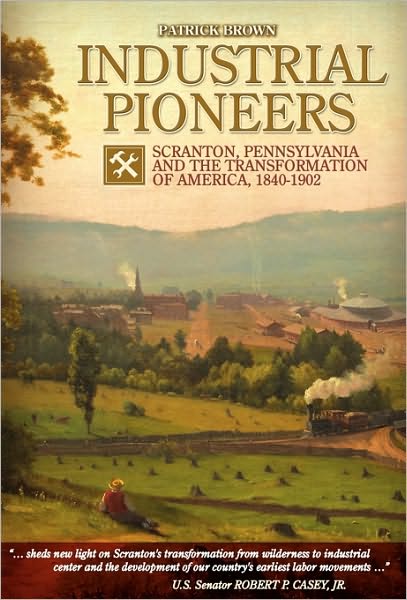
Patrick Brown was born in Scranton, Pennsylvania. He graduated Magna cum Laude from Georgetown University, where he won the Morris Medal for best senior history honors thesis. He currently teaches high school social studies in the Mississippi Delta through Teach for America.
About Industrial Pioneers: Scranton, Pennsylvania and the Transformation of America, 1840-1902
During the nineteenth century, Scranton was the face of innovation, immigration, industrialization, and a rising America. Scranton was “the electric city” when electricity was the most exciting invention in the world, and a hub of technology and innovation—between 1840 and 1902, the city of Scranton changed from a lazy backwoods community to a modern industrial society with 100,000 residents. During this time, Scranton’s citizens desperately tried to adapt their thinking to keep up with the overwhelming changes around them, and in the process forged the world views that would define the twentieth century. As globalization, technology and immigration transform the United States today, this book revisits how the people the forefront of the industrial revolution moved from chaos to a new order, and how they found meaning within a rapidly changing world.
Periods of total societal transformation often provide the best material for historians. The way that Scranton’s residents reimagined their value within society in response to the changes around them did not evolve in step with technological and economic progress—rather, those living through these changes slowly and painfully adapted extant modes of thinking in light of their new life circumstances. This book weaves a cohesive narrative that explains how Scranton—and America—went from the personal, egalitarian society of the early days of the republic to the rigidly institutionalized society that endures today.
This book’s investigation of the history of Scranton allows the reader to witness the development of the distinct and interrelated ideologies that defined industrial America.
Read the Excerpt!
INTRODUCTION: The Face of America “If the American white working class were a sect, Scranton, Pennsylvania, might be its Jerusalem. The old coal town has declined steadily since its heyday in the middle of the last century. Hillary Clinton played up her family roots in Scranton during the Democratic primaries against Barack Obama, drawing large support from anxious, white, working classes. In turn Mr. Obama chose a running mate, Joe Biden, in part for his own ties to the town: Mr. Biden spent his childhood in Scranton. On Sunday November 2nd the latest Scranton-lover was John McCain, who gave a speech there. His slim hopes for the presidency rely on sowing enough doubts in places such as northeastern Pennsylvania to overcome the polls and win that state.”
— The Economist, November 3, 2008 —
(one day before the presidential election)
Scranton, Pennsylvania, seemed to be everywhere during the 2008 presidential election campaign. Politicians flocked to the city because it embodied many concerns of voters throughout America—jobs sent overseas; businesses struggling to adapt to a 21st century economy, and citizens trying to defend a traditional set of values in a rapidly changing world. Throughout the late twentieth century, Scranton has been, as the title of a 2005 book suggests, “The Face of Decline” in the United States, and presidential candidates seeking to reassure voters concerned about the future of the nation could find no better platform.
What most political candidates and talking heads probably did not realize during the campaign is that during the nineteenth century Scranton served as the face of a rising America, and a hub of technology and innovation. The city was the first in the nation to produce the iron rails necessary to expand the nation’s railways, and it mined the anthracite coal and forged the steel that drove America’s industrial revolution. In 1886, Scranton began operating the nation’s first electric streetcar system, earning it the nickname, “The Electric City,” at a time when electricity was the most exciting innovation in the world. Scranton was, in a sense, the Silicon Valley of the nineteenth century.
Scranton also served as the face of immigration during the nineteenth century, as immigrants from across England, Wales, Ireland, Germany, Italy, Poland, Russia, and throughout Europe flocked to the city in search of employment. As a city at the epicenter of the economic, social, and political changes sweeping the nation, Scranton was truly the face of industrializing America.
Periods of extraordinary change often provide the best material for historians, and perhaps the most remarkable facet of Scranton’s development is the fact that the city grew from an egalitarian backwoods community to a modern industrial society of 100,000 residents in sixty-two years. The way Scranton’s residents thought about themselves and their value within society did not evolve in step with technological and economic progress—rather, those living through these changes slowly and painfully adapted extant modes of thinking in light of their new life circumstances. Identifying the mindset of Scranton’s residents at the commencement of industrialization and tracing how events and developments affected the thinking of those living in the city, weaves a unified narrative that explains how Scranton—and America—went from the personal, egalitarian society of the early days of the republic to the rigidly institutionalized society that endures today. In the development of Scranton from 1840 to 1902, Scranton’s residents passed through four distinct mindsets in their quest to reconcile their assumptions about the world with their life experiences.
Many books and articles describe certain aspects or elements of this period, but the period from 1840 to 1902 is a unified story.
Residents of Scranton like Frederick Hitchcock and Benjamin Throop wrote books intended as histories of the city during the nineteenth century, but these works must be understood as heavily biased primary sources.
Every in-depth secondary source on the city focuses on a specific element related to the city’s development.Grace Palladino examined the relationship between labor, capital, and the state during the Civil War. Multiple authors, including Craig Phelan, chronicled Terence Powderly’s dual role as mayor and union leader. Harold Aurand studied the conditions of coal miners throughout the region. R.G. Healey modeled the business dynamics of the coal industry. Multiple works discuss the 1902 anthracite strike, and a number of authors focus on specific ethnicities within the city. No work, however, has brought all of this rich material together to trace the rise of the city over an extended period. For the sake of clarity, what follows is organized both chronologically and categorically.
The first chapter covers the years 1840 to 1860, and describes the Village Blacksmith ideology, which predated Scranton’s industrial development. Before the Scranton family began producing iron in the area, residents lived like the village blacksmith in the Henry Wadsworth Longfellow poem of the same name. They derived respect from their status as independent producers and members of an egalitarian community. During the twenty-year period covered by this chapter, Scranton grew from the small town of Slocum Hollow to a rapidly expanding industrial city integrated into the national market. This growth created opportunities for ambitious individuals to prosper, but residents retained their pre-industrial assumptions. Noninstitutional power, like the power of personality in the workplace, retained its importance within the community through most of the period. By 1860, however, a capitalist ideal, distinct from the Village Blacksmith ideal, was emerging.
The second chapter explores the development of the city between 1860 and 1877, examining how two remarkably similar men, Thomas Dickson and Terence Powderly, came to articulate opposing viewpoints. While Dickson attained extraordinary success as the founder of the Dickson Manufacturing Company and later as president of the Delaware and Hudson Canal Company, Powderly failed in his attempts to break into the capitalist class early in his life, and instead turned to organizing labor through unions.
The chapter describes how the Civil War spurred rapid economic growth in Scranton, and how subsequent economic downturns revealed the crystallization of distinct capitalist and labor classes through the strikes of 1869, 1871, and 1877. Throughout this period, workers could not reconcile their worldview with their status in a cyclical economy, and the resulting frustration led to the riots of 1877, in which workers resorted to violence, but failed to defeat the combined forces of capital and state government.
The third chapter examines the period of 1878 to 1886, during which Terence Powderly worked for social, political, and economic reforms that extended across occupational, ethnic, and gender lines. In Powderly’s dual role as mayor of Scranton and Grand Master Workingman of the national Knights of Labor union, the largest labor organization in the United States in the 1880s, he unsuccessfully attempted to translate the frustration evidenced by the riots of 1877 into a broad and enduring working-class identity. The chapter describes the importance of ethnicity in the workplace, at the voting booth, and in society, and argues that Powderly’s belief in the coincidental interests of labor and capital led to the failure of his ideas. By 1886, the Knights of Labor was collapsing, Powderly’s political career had ended, and workers in Scranton once again encountered an ideological vacuum.
The fourth chapter chronicles the emergence of the trade union ideology and capital mobility during the period 1886-1902. The chapter describes the terrible living conditions of mining families, and the disrespect directed to them by their employers. In an attempt to ameliorate these conditions, the United Mine Workers arrived in Scranton in 1899, and began organizing the area’s miners.
Two major events occurred in 1902. An anthracite coal strike called by the United Mine Workers proved so disruptive to the national economy that it forced intervention by the federal government, and the Lackawanna Iron and Steel Company relocated its production facilities to Buffalo, New York.
These two events foreshadowed the characteristics of industrial America in the twentieth century. Organized labor developed effective organizational strategies, and the state progressively enacted more labor-friendly legislation, but in response to labor’s success in demanding higher wages, organized capital used ethnic and occupational divisions to divide workers, and periodically moved production to new locations in order to take advantage of an unorganized workforce.
Taken together, these four chapters trace the trajectory of industrializing Scranton. The four chapters overlap at points. Ethnicity played an important role in the development of Scranton between 1860 and 1877, the cyclical economy operated from 1878 to 1902, and miners faced deplorable conditions throughout the entire history of the city.
Understanding these events and forces is essential to an understanding of the processes, trends, and, most important, ways of thinking that defined Scranton’s growth, and presaged developments brought on by industrialization and urbanization throughout the United States. This is the clearest means to understand an immensely rich period of history.
My Thoughts
What an amazing book! Mr. Brown does a wonderful job walking us through the this important part of Scranton's history. He presents the facts in an easy read and understand format. He uses and refers to Longfellow's poem " The Village Blacksmith" throughout the book. I found it interesting and really causes the facts to "hit home".
This book is a fascinating read and really brings to light the importance of Scranton's role in the transformation of not just the East, but American itself. This is a great book for both history buffs and those that are interested in PA history!
This book was supplied through Pump Up Your Book for me to honestly review.
It is time for a FIRST Wild Card Tour book review! If you wish to join the FIRST blog alliance, just click the button. We are a group of reviewers who tour Christian books. A Wild Card post includes a brief bio of the author and a full chapter from each book toured. The reason it is called a FIRST Wild Card Tour is that you never know if the book will be fiction, non~fiction, for young, or for old...or for somewhere in between! Enjoy your free peek into the book!
You never know when I might play a wild card on you!
***Special thanks to Jennifer Nelson, PR Specialist, Hannibal Books for sending me a review copy.***
ABOUT THE AUTHOR:
Author Kay Wheeler Moore has written and spoken widely on the subject of relationships and family life. She is the author of Way Back in the Country; When the Heart Soars Free, a book of Christian fiction; and Gathering the Missing Pieces in an Adopted Life, based on her Houston Chronicle newspaper series that was nominated for a Pulitzer Prize. She has also been a newspaper city editor and a reporter for United Press International.
List Price: $14.95 Paperback: 224 pages Publisher: Hannibal Books (May 1, 2010) Language: English ISBN-10: 1934749710 ISBN-13: 978-1934749715
AND NOW...THE FIRST CHAPTER:
Chapter 1: “We Were Rich”
The screen door to the farmhouse creaked open and then quickly slapped shut.
Without glancing up from her ironing board Grandma Harris knew the next sound would be that of feet pit-patting from the front porch into the living room and halting abruptly at her dining table.
Those feet, Grandma knew, could belong to any of several of her grandchildren, whose stopovers at her house were part of their regular home-from-school itinerary.
“Oh, yum, she’s got a fresh bowl full,” Grandma heard a high-pitched squeak emerge. That would be Mable, the youngest of Grandma’s daughter, Mattie, who lived across the pasture with her family.
“I was here first, Mable,” a slightly older voice cajoled. Frances, Grandma’s namesake, got irritated easily with her smaller sibling. “Don’t hog the crackers so I can have the first dip.”
“We’ve all gotta be quick before the others get here,” the oldest one, Bonnie, warned her younger two sisters. They glanced over their shoulders to see whether any of their cousins were hungrily making their way onto Grandma’s porch.
“Girls, I got plenty of tomato preserves fer ever’one—for you and yer cousins,” Grandma gently chided. She stepped from the kitchen to hug her granddaughters, who competed for the first taste of the thick, sweet treat that awaited them as an afternoon snack. “Take turns, now, so I won’t have t’ tell yer mama ya didn’t share politely.”
Grandma Harris had put out the new batch of tomato preserves earlier that day after Grandpa fetched several jars from the storm cellar which had housed them since the summer’s canning. Grandma’s long, hot days of putting up delightful red tomatoes from their garden had yielded a treasure trove of preserves Grandma could share throughout the fall and winter.
In mid-afternoon Grandma had opened the first jar and ladled its contents into a wide-rimmed, cutglass compote that stood on a gleaming, glass-stemmed pedestal in the center of her dining table. The cutglass glistened like diamonds as it reflected the sun’s light filtering through the room. Into a separate dish Grandma had set out some saltine crackers. On this particular afternoon her red-haired granddaughters—Bonnie, Frances, and Mable Miller—were the first snack-seekers.
No doubt they’d soon be followed by some of the youngsters of her other sons and daughters whose homes were also nearby.
Ultimately Grandma Harris would go on to begat 52 grandchildren in all, but she never ran out of treats for them or resourceful ways to prepare the many vegetables that she and Grandpa Harris grew in their everlastingly prolific garden. Every Sunday Grandma prepared an enormous, after-church dinner for all of her 11 children and their families who could attend.
Because their farmhouse was closest to Grandma’s, the “Three Red-Haired Miller Girls”, as many in their community of Brushy Mound knew them, hardly ever missed a Sunday—or an after-school afternoon—at Grandma’s house, where her good cooking always abounded.
* * * * * * * * * *
A century later the Harris farmhouse built on the rich, black soil of Delta County, TX, has long ago crumbled down. Grandma’s abundant garden has been plowed under with only a few derelict weeds to mark the spot where those sweet-ascandy tomatoes grew so bountifully. For more than 65 years grass has grown unbidden around the tombstone marked “Frances E. Harris”—the Miller girls’ beloved “Grandma”.
But down all the decades, the memory of Grandma’s delectable tomato preserves served in the sparkling, pedestaled compote would remain fresh in the mind of her namesake—little Frances, who was still recounting the tomato preserves story well into her 103rd year on this earth.
“We were rich,” Frances recalled to us nieces and nephews, who discreetly pumped her for just one more of her “olden-days” country tales before night would fall on her memory forever. This font of family lore was the last surviving member of that generation of our kin. At 102 years and 1 month of age Frances could still describe picking melons the size of basketballs, okra rows that were city blocks-long, and cornstalks that seemed to stand tall as skyscrapers.
Although farm families such as hers usually lacked financial means, the garden insured that no one would go hungry. Just before supper each night Mama faithfully sent Frances and her sisters out to see what was ready to be plucked from the vine and cooked up for that night’s meal.
“We had no idea we were poor,” Frances mused from her wheelchair, “because we always had food from the garden.”
* * * * * * * *
At the time Frances related her last tomato preserves story before her passing in May 2009, people everywhere were turning to backyard patches of earth again for the same reason the Miller girls and their mama and grandma did in the early part of the last century.
Economic woes in the United States and around the world have caused family incomes to plummet. Home-gardening has become a passionate new interest for people who have never planted a seed or worked a hoe. Even the wife of the U.S. President at the time, as an example for others, grew vegetables in her own White House garden. Heads of households can gaze on small stretches of garden dirt and comfort themselves in the same way Frances’ family did. After all, the Great Depression, which clouded the Miller Girls’ youth in rural northeast Texas, did not sting as much to those who could till the soil and cultivate its yield. With food from the garden, they could always feed their families and feel “rich”, no matter how lean the times or how thin the pocketbook.
My earlier cookbook, Way Back in the Country, emphasized that food, the recipes for how to prepare it, and the stories of people who cooked them are all interwoven into the fabric of family life. Way Back in the Country encouraged families to preserve not just their legendary recipes but the lore of the loved ones—such as the indomitable Grandma Harris—who made them popular. Through tales of the Red-Haired Miller Girls—my mother, Mable, and her two sisters, Frances and Bonnie—and six generations of their farm kin and the recipes that have been regulars at family gatherings for decades, Way Back in the Country inspired others to get their tape-recorders out and investigate why “Great-Aunt Gertie” always brought lemon pound cake whenever their extended families dined.
With gardening surging in popularity once more, the time seems right to revisit the Miller-Harris legends and recipe chests—this time to celebrate the role that food from one’s own soil has always played in American homes and how, in the Tight Times of this Great Recession, it makes us feel “rich” with hope and comfort afresh. Way Back in the Country Garden again will intertwine six generations of my family’s anecdotes with cooking instructions that will probably remind you of some of your own family favorites.
So prepare to laugh, cry, and traipse down memory lane once again with the Red-Haired Miller Girls and their progeny—through yarns my family told—yarns that I didn’t always witness firsthand but can try to recreate as I can envision them happening in my mind’s eye. May you soon be preserving some country gardening tales of your own and savoring the memories and tastes of yesterday.
All rights reserved under International Copyright Law. Contents may not be reproduced in whole or in part in any form without the express written consent of the publisher.
My Thoughts:
I absolutely love this book! It contains so many fun and well told stories of family in East Texas with recipes that go with each story. The way the stories are told, makes me think of how I used to set among the elders at our family gatherings and listen to them tell their tales - some funny, some informative, but all heartwarming and entertaining.
More than two-thirds of the book is composed of a story with a recipe. The author also included a family tree and photo album filled with pages of family photographs. The last part of the book contains many family recipes.
I enjoyed the tales of the Miller girls and the Harris family, and the recipes I tried were not only delicious, but some were surprisingly similar to those that my own family made.
This is the second book in Kay Wheeler Moore's series. "Way Back in the Country" is the first, and must find its way into my collection. Kay has not only given her family a treasure with the recording of her family stories and recipes, but she has also blessed the rest of us.
"Way Back in the Country Garden" is a must for any kitchen library or anyone interested in American history. I highly recommend it!
This book was provided by FIRST for me to honestly review.


.jpg)